

As the European Union is moving towards the operational implementation of the Carbon Removal and Carbon Farming Certification Framework (CRCF), understanding stakeholders' perspectives is becoming increasingly important. The new paper published within LIFE VitiCaSe contributes to this debate by analysing the opportunities and barriers associated with the adoption of carbon farming practices in Italian vineyards.
The research focuses on a fundamental aspect of the transition towards climate-smart viticulture: while the technical potential of carbon farming practices is increasingly recognised, their successful adoption also depends on farmers' expectations, perceived barriers, economic opportunities and the broader governance framework.
Using a two-step participatory approach involving Italian stakeholders from the wine sector, the study addresses three key questions:
- How do stakeholders perceive the opportunities and challenges associated with the adoption of carbon farming practices in vineyards?
- Which environmental, economic and social factors are considered most relevant for supporting the transition towards carbon farming?
- Which recommendations can help design effective policies, certification schemes and support mechanisms to foster the large-scale uptake of carbon farming in viticulture?
Full article available on: https://doi.org/10.1016/j.sftr.2026.102120
Below are some excerpts from the paper.
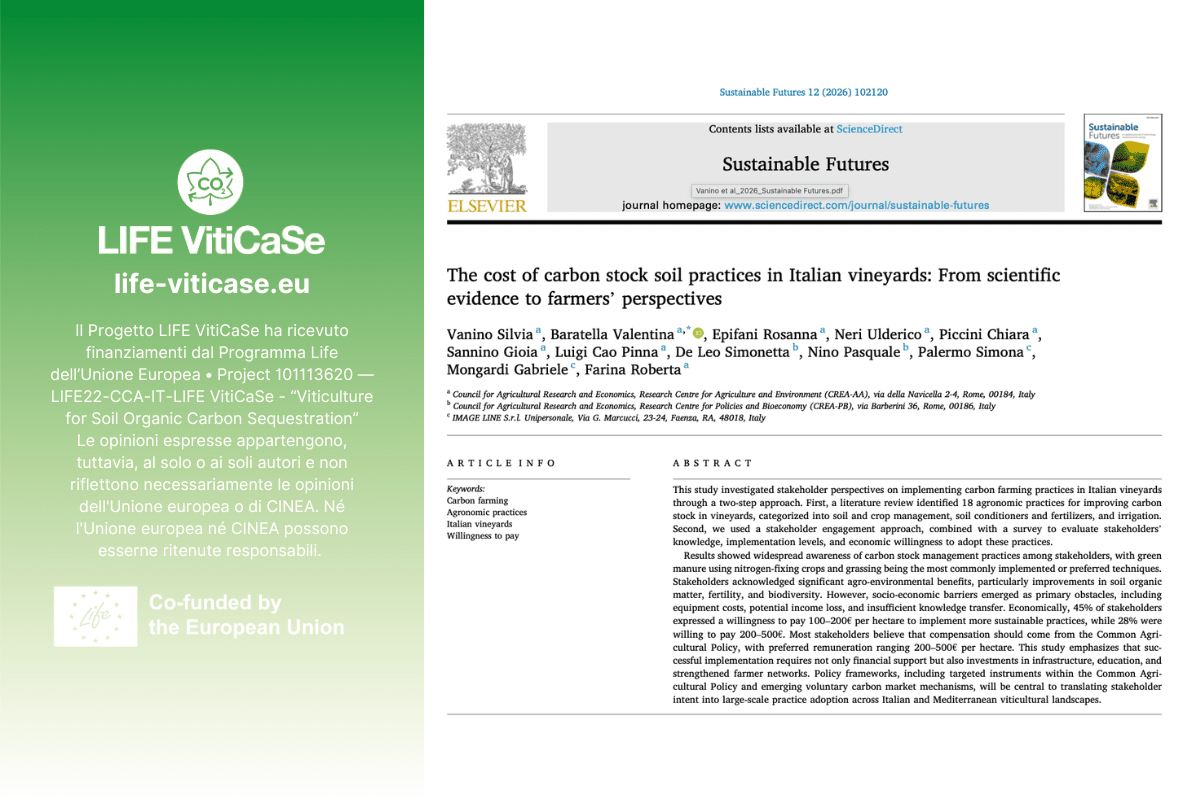
Source:
Vanino Silvia, Baratella Valentina, Epifani Rosanna, Neri Ulderico, Piccini Chiara, Sannino Gioia, Luigi Cao Pinna, De Leo Simonetta, Nino Pasquale, Palermo Simona, Mongardi Gabriele, Farina Roberta,
The cost of carbon stock soil practices in Italian vineyards: From scientific evidence to farmers’ perspectives,
Sustainable Futures,
Volume 12,
2026,
102120,
ISSN 2666-1888,
https://doi.org/10.1016/j.sftr.2026.102120.
(https://www.sciencedirect.com/science/article/pii/S2666188826004776)
Introduction
The present study addresses both gaps by integrating an evidence-based agronomic review with a stakeholder survey, with the dual aim of strengthening science-policy knowledge and supporting more informed decision-making.
A key aspect of this research is to understand the reasons why farmers are hesitant to adopt practices with improved sustainability performance, even when they are aware of their existence, and to identify the main barriers and the potential opportunities for their adoption. Expanding applied research and cost-benefit analysis, and the long-term impact of these practices, is crucial for improving adoption rates of SOC-building practices in the context of climate change. A clear understanding of stakeholders’ willingness to pay for sustainable agriculture and their perception of the most effective policy measures is fundamental to developing sound support strategies. To fully exploit EU's vineyards climate change mitigation potential, it is essential to systematise technical aspects such as soil and crop management, and to provide vine growers with the knowledge and the tools that can allow them to adopt cultivation techniques enhancing C sequestration. In this framework, the LIFE VitiCaSe project (https://www.life-viticase.eu/en) aims to provide farmers with such operational indications (practices and technologies) fostering an increase in the soil organic carbon content in vineyards.
This paper aims to provide a novel perspective on the implementation of carbon farming practices in Italian vineyards by integrating scientific evidence with stakeholder adoption behaviour, focusing on soil management techniques and technologies that enhance soil C storage. To this purpose, the study presents: (i) a review of CF practices, based on experimental studies conducted in Mediterranean vineyards, (ii) a list of good agricultural practices, most suitable for increasing soil C stocks, particularly in vineyards, along with an assessment of their economic and environmental pros and cons, and (iii) the results of a stakeholder engagement process to evaluate the perceptions of different stakeholder groups regarding the application of sustainable soil practices to improve C stocks in vineyards, emphasizing the environmental benefits and the stakeholders' willingness to pay a value for the application of sustainable farming practices. The adoption of a structured stakeholder engagement approach to explore the divergent views among stakeholder groups constitutes the main added value of this stocktake, filling an existing gap in understanding how knowledge exchange and mutual trust can be strengthened among those engaged in sustainable soil management in vineyards.
Abstract:
This study investigated stakeholder perspectives on implementing carbon farming practices in Italian vineyards through a two-step approach. First, a literature review identified 18 agronomic practices for improving carbon stock in vineyards, categorized into soil and crop management, soil conditioners and fertilizers, and irrigation. Second, we used a stakeholder engagement approach, combined with a survey to evaluate stakeholders’ knowledge, implementation levels, and economic willingness to adopt these practices. Results showed widespread awareness of carbon stock management practices among stakeholders, with green manure using nitrogen-fixing crops and grassing being the most commonly implemented or preferred techniques. Stakeholders acknowledged significant agro-environmental benefits, particularly improvements in soil organic matter, fertility, and biodiversity. However, socio-economic barriers emerged as primary obstacles, including equipment costs, potential income loss, and insufficient knowledge transfer. Economically, 45% of stakeholders expressed a willingness to pay 100–200€ per hectare to implement more sustainable practices, while 28% were willing to pay 200–500€. Most stakeholders believe that compensation should come from the Common Agricultural Policy, with preferred remuneration ranging 200–500€ per hectare. This study emphasizes that successful implementation requires not only financial support but also investments in infrastructure, education, and strengthened farmer networks. Policy frameworks, including targeted instruments within the Common Agricultural Policy and emerging voluntary carbon market mechanisms, will be central to translating stakeholder intent into large-scale practice adoption across Italian and Mediterranean viticultural landscapes.
Keywords: Carbon farming; Agronomic practices; Italian vineyards; Willingness to pay
Acknowledgements
This work was developed in the framework of the LIFE programme supported by the European Union LIFE22-CCA -IT-LIFE-VitiCaSe (https://www.life-viticase.eu/en). The views expressed in this article are the author's sole responsibility and do not necessarily reflect the views of the European Commission. The authors would like to thank all the stakeholders who participated in the consultations.