

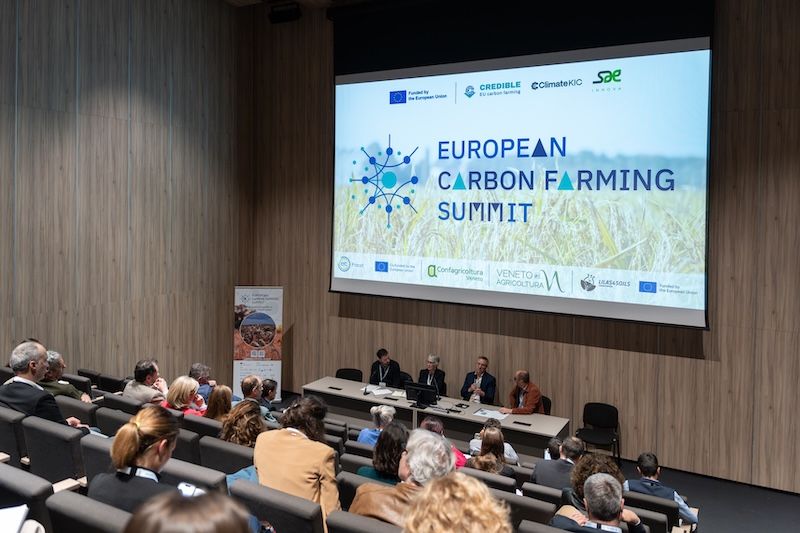
From 17 to 19 March 2026, Padua hosted the 3rd EU Carbon Farming Summit, one of Europe’s leading events on the subject, organised by SAE Innova and Climate KIC as part of the Credible project consortium, with EIT Food / EIT Food South acting as coordinator of LILAS4SOILS and Confagricoltura Veneto, and with the support of Veneto Agricoltura. The event brought together institutions, researchers, businesses and, above all, farmers, with a common goal: to understand how to make carbon farming a concrete, effective and scalable practice within European agricultural systems.
In this context, the LIFE VitiCaSe project played an active role, co-organising the session “Giving Voice to Farmers: From Practice to Proof in Carbon Farming” alongside Farm Carbon Toolkit and Teagasc, with the aim of placing farmers’ direct experiences at the heart of the debate.
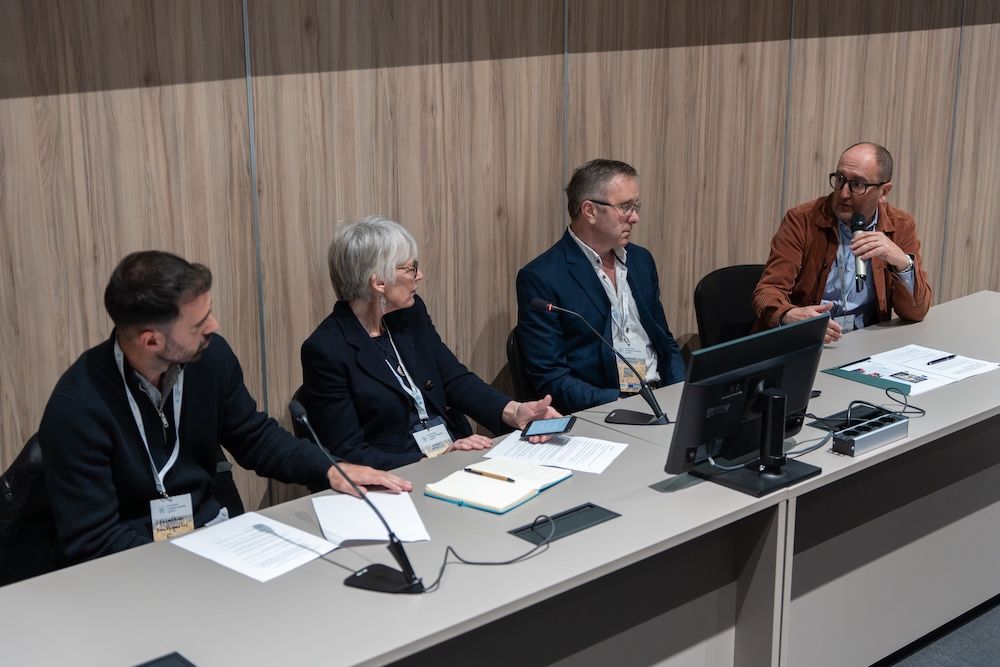
The panel, moderated by Liz Bowles, CEO of Farm Carbon Toolkit, featured three farmers from different European backgrounds who shared concrete experiences of adopting carbon farming practices: Andrew Brewer, a livestock farmer from Cornwall; Stathis Stathopoulos, an olive grower from the Peloponnese; and Carlo De Biasi, a winegrower and director of San Felice Wine Estates, a partner in the LIFE VitiCaSe project.
Event recording
The recordings of the panel are available on Youtube at this link
From the very first discussions, one key point became clear: for farmers, carbon farming is not an end in itself but a consequence of management practices aimed at improving soil health.
The practices adopted – cover crops, reduced tillage, improved fertilisers management, precision technologies, etc. – are in fact driven first and foremost by the need to maintain or restore the soil’s biological fertility, in order to increase farm resilience, particularly in the face of changing climatic conditions.
Alongside this issue, the comparison of different experiences has highlighted another key factor: the need to support farmers through this transition. The barriers, in fact, are not merely economic or technical, but also relate to mindset and access to knowledge. In this regard, it emerged strongly that a key factor for farmers is the opportunity to exchange views with peers and share practical experiences; this aspect could serve as a fundamental lever to accelerate the adoption of these practices.
Despite these difficulties, the message coming from the farmers is far from one of waiting and seeing. On the contrary, many have already embarked on this path and intend to continue along it: when asked directly whether they would continue on this path even if there were no future incentives, all three farmers answered clearly: yes!
This shows that they are driven not so much by the prospect of entering the carbon credit market as by the tangible benefits they see on their own farms: more fertile soils, greater resilience to extreme weather events, and reduced reliance on fertilisers.
Farmers undoubtedly bear the most risk associated with a change in farming practices, both in terms of productivity and initial investment; it is therefore important to support this transition through incentives or mechanisms such as the carbon credit market.
But what Carlo De Biasi so effectively said is even truer: the real risk today is not changing.
Several speakers during the panel discussion also highlighted how current carbon accounting models struggle to capture the complexity of agricultural systems and, above all, to fully recognise the benefits generated by the practices adopted. In particular, certain requirements under current certification schemes risk failing to fully recognise the increase in soil carbon, and above all its maintenance over time; one such requirement is the ‘additionality’ criterion, which we could simplify by saying that farmers are only credited with carbon credits generated by new practices adopted in addition to their standard management practices. This can therefore penalise those farmers who have long been adopting sustainable soil management practices.
This disconnect represents not only a technical limitation but also a potential obstacle to the development of carbon farming. If the benefits generated are not recognised, it becomes more difficult to build robust and attractive economic models for farms, especially at a stage where certification systems are still complex, costly and not easily accessible to small and medium-sized farmers.
For LIFE VitiCaSe, participating in the Summit and organising this session represent an important opportunity for discussion and knowledge-sharing, in which the experience gained in the field helps to fuel an ongoing European debate. A debate which, as became clear in Padua, cannot ignore the voice of farmers.