
In the second week of January, the LIFE VitiCaSe project hosted a monitoring visit by the Validation and Verification Body (Carbon Check), a key milestone in the validation and certification process for the carbon credits generated by the project. This visit is part of an independent audit conducted as part of the certification process; the goal is to obtain registration with the ICR (International Carbon Registry), an ICROA-approved registry. The visit represents an official review of the practices implemented in the vineyards to verify their compliance with the requirements of the credit generation standard. Agronomists from the partner wineries participated, along with staff from Image Line (LIFE VitiCaSe lead partner), Carbon Credits Consulting, and the CREA research institute.
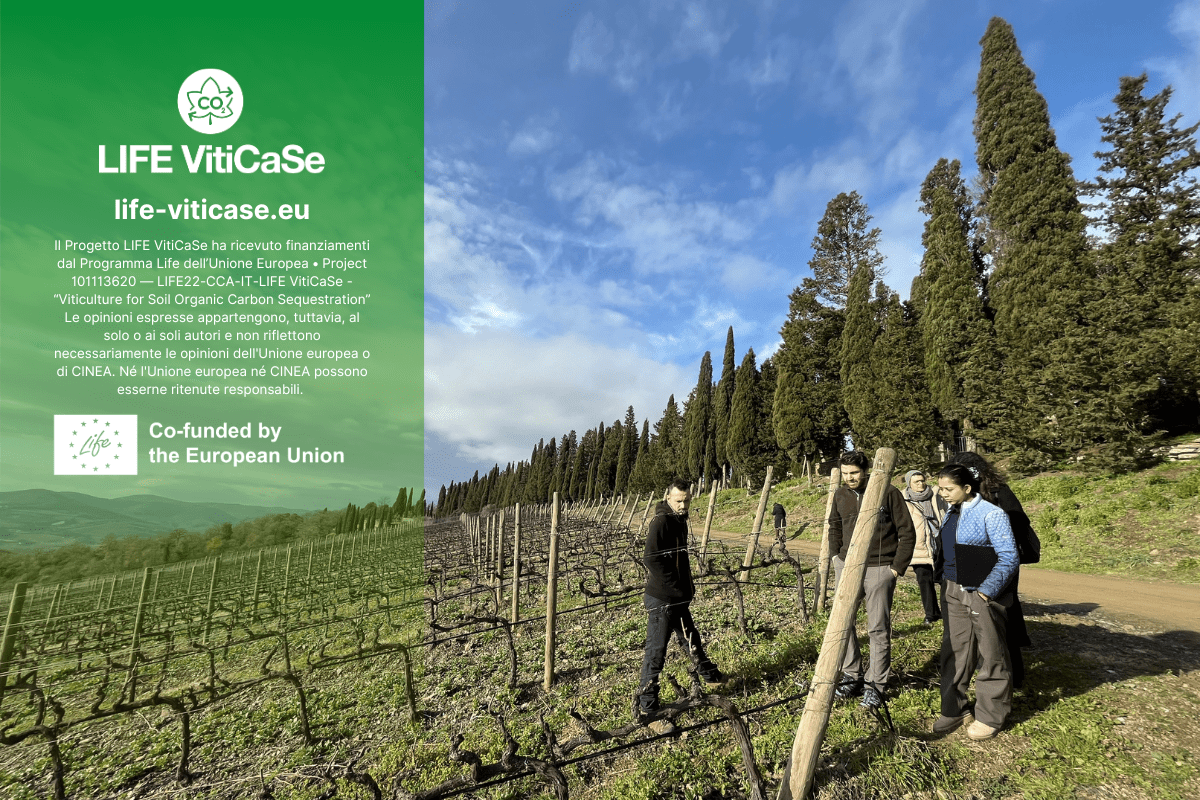
The field assessment of the agronomic practices adopted by the partner wineries focused on sustainable and regenerative soil management strategies, as well as evaluating the monitoring, reporting, and validation (MRV) processes developed within the VitiCaSe project. An in-depth analysis involving both the experimental plots and the data flows and digital procedures used to quantify soil carbon stocks.
The comparison with the VVB represents a key step in ensuring the scientific robustness, transparency, and credibility of the carbon credits produced, strengthening the link between virtuous agricultural practices, reliable measurement of climate impacts, and access to voluntary market instruments.
This activity takes on even greater significance in light of the entry into force of the Soil Monitoring Law, the first European regulation comprehensively dedicated to soil health. The new law recognizes soil as a strategic resource for food security, climate resilience, and biodiversity protection, promoting harmonized monitoring systems based on scientific data.
In this context, LIFE VitiCaSe confirms its role as a pilot project aligned with the most recent European policies, demonstrating how viticulture can become an advanced laboratory for climate innovation, capable of combining environmental sustainability, digital tools, and economic opportunities for agricultural businesses.
VVB's visit therefore marks a further step towards the replicability of the VitiCaSe model and its concrete contribution to the transition to healthier soils and climate-smart agricultural systems.
Want to learn more about the project's certification?
Visit https://www.carbonregistry.com/projects/life-viticase-396 and discover all the details on the Downloads page of our website.
All the details on the Soil Monitoring Law:
https://environment.ec.europa.eu/topics/soil-health/soil-monitoring-law_en
https://environment.ec.europa.eu/news/first-eu-law-soil-set-enter-force-2025-12-05_en